
Financial literacy is not just about knowing how to balance a checkbook or read a budget. It is about economic opportunity, the freedom to make informed decisions, build wealth, and move up the economic ladder. Yet across communities in the United States, too many students and adults lack even the most basic financial knowledge, and the consequences affect families, neighborhoods, and the broader economy.
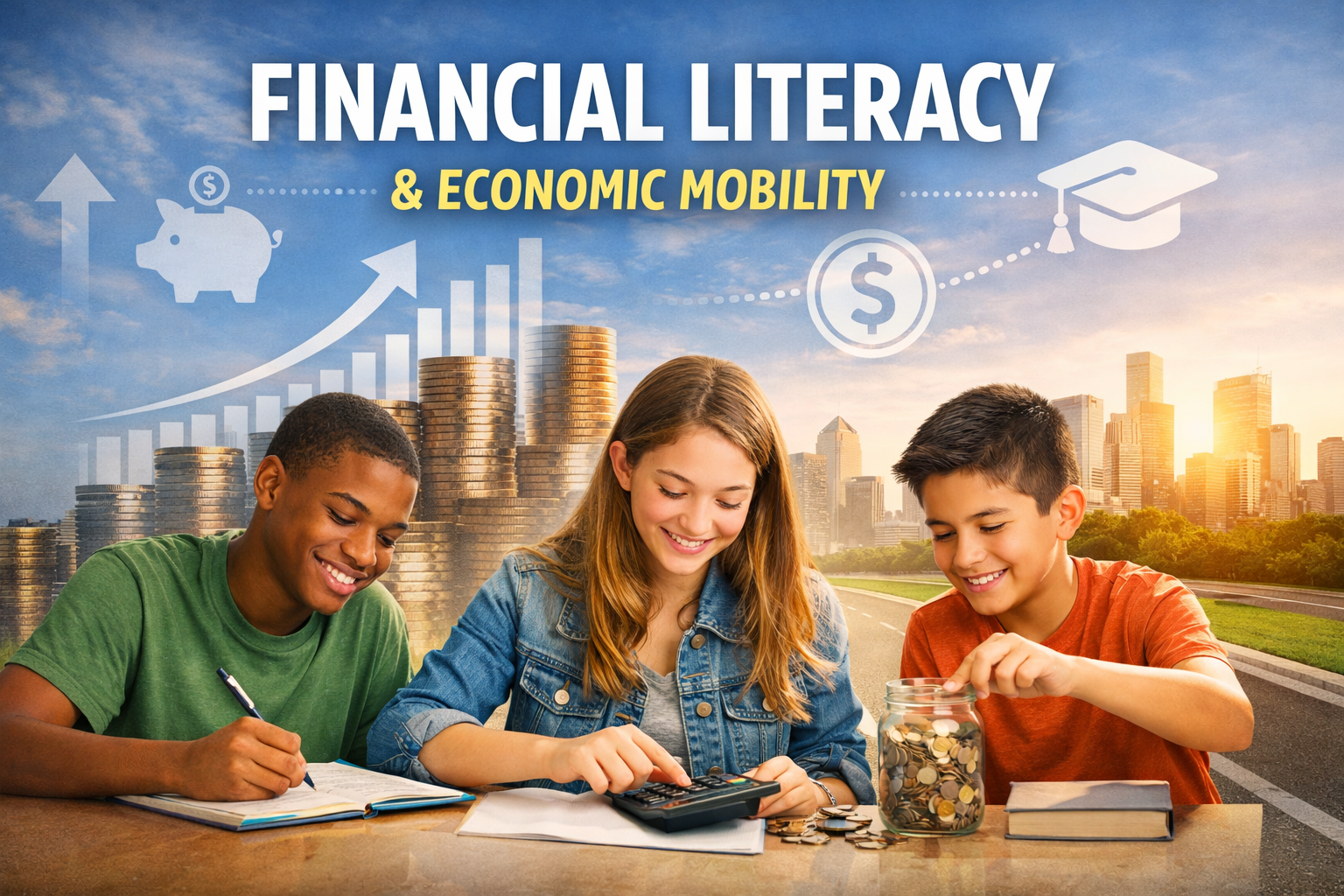
Research consistently shows that American adults struggle with basic financial concepts. On average, U.S. adults correctly answer only about half of fundamental financial literacy questions, highlighting persistent gaps that leave families financially fragile and less prepared to plan for the future.¹
Low financial literacy limits economic mobility.
Adults with weaker financial skills are more likely to carry high levels of debt, lack emergency savings, and live paycheck to paycheck rather than building stability over time.² These households also have less access to lower cost financial products and are more likely to rely on high cost borrowing, which traps families in cycles of financial stress and prevents them from investing in education, homeownership, or entrepreneurship.³
When financial knowledge does not improve, economic mobility suffers.
Households with limited understanding of credit, interest, and savings are far less equipped to build long term wealth, which is a primary driver of upward mobility.⁴ These challenges disproportionately impact low income families and communities of color, reinforcing intergenerational wealth gaps and systemic inequality.²
The evidence is clear that financial education changes outcomes.
Students who receive personal finance instruction in school are more likely to develop healthier financial behaviors later in life, including improved credit scores and lower delinquency rates.² Financial education also increases students’ likelihood of using lower cost financing options and reduces their dependence on high interest credit.³
At ClassBank, we believe financial literacy is not an optional add on. It is a foundational life skill.
When students practice earning, saving, and spending through a classroom economy, they build confidence in real world money decisions that follow them into adulthood. Schools that embed financial learning into daily culture are not just improving behavior and engagement, they are helping to unlock long term economic mobility for every student.
Economic mobility is not just about wages or jobs. It is about the skills and confidence to manage money wisely over a lifetime. Financial literacy is one of the most powerful tools schools can provide to help students break cycles of insecurity and build lasting opportunity.
Footnotes
.svg)